Including VASER and Renuvion
Overnight stay at the hospital
During your hospital stay, you won’t receive Manual Lymphatic Drainage (MLD) therapy, as you’ll have drains in place and will need to wear compression garments until the drains are removed. Although the drains may be uncomfortable, they are crucial for removing excess fluid and giving your body the best start to recovery.
Make the most of the drains attached
Tips for a Faster Recovery: Start Moving Early
It’s important to start mobilizing as soon as possible to support your recovery. Once your catheter is removed, walking will become easier, and you’ll feel more comfortable. While pain medications can make you feel drowsy and weak, staying in bed too long can lead to increased stiffness due to lactic acid buildup in unused muscles. To avoid this, try to get out of bed regularly, even if it’s just for a short walk. Movement not only helps with stiffness but also promotes better fluid drainage, reducing the amount your body needs to process.
Suggested exercise to reduce muscle stiffness
✍🏻The most effective way to relieve pain is to move.
Get up on your toes to engage your calf muscles and bend your knees to engage your quad muscles. It improves blood circulation in the legs, it reduces lactic acid build-up in the body and takes weight off your legs as well. Any muscle you move helps the circulation (blood and lymph) throughout your body.
For your arms. Elevate your arms on pillows on the side of your body where your wrists are at shoulder level, this way gravity will be towards the armpit which will help drive fluid in the direction of lymph flow. Keep your arms straight, don’t bend at the elbow. Move your fingers, play virtual piano, close your fingers in a fist and open again in the shape of a fan, do this a few times. After that, include wrists – rotations – palms up and palms down.
Week 1 – Garments and at home treatments
Wear garments – The BOD® foam corset protects the skin from creases and folds, and a compression garment provides the compression. These two must be worn together as a set, and only take them off to shower or for a treatment. Being without compression for prolonged periods would cause your body to swell up even more, and getting back into compression feels more uncomfortable.
✍🏻Note: You are allowed to take the garments off two times a day. If you are having a treatment in the morning 1-1.5h (this is one time). The second time can be in the evening for a stretch and shower. Or the other way around, but remember – do not stay out of compression garments for longer than needed. The longer you have the compression off – your body swells, and the garments will feel tighter afterwards.
Iron deficiency. Supplementation. Post-op Nutrition.
After surgery, you may experience symptoms of Iron deficiency anaemia, a common type of anaemia – a condition in which blood lacks adequate healthy red blood cells (RBCs). RBCs contain a protein called haemoglobin, and their primary function is to carry oxygen from our lungs to the rest of our bodies. All the systems in our body rely on oxygen to make energy. If our blood didn’t move the oxygen we breathe into our organs and tissues, we wouldn’t be able to carry out normal functions such as moving our muscles, digesting food or thinking.
Iron is needed to form haemoglobin. When you lose blood, inevitably, you would lose some iron as well. Iron is an essential mineral that plays a vital part in proper growth and development. Some patients start taking the Iron supplants days before the surgery to build up a reserve and don’t experience fatigue as much. Here are some iron-rich foods that can be added to your menu and others that help with its absorption read here.
Week 2 – ultrasound, massage, skin rolling
By now, you should be familiar with the benefits of massage and movement, so continue with the routine from week 1, and start implementing
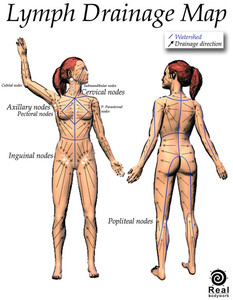
a little bit of skin rolling as well to work on the sides of the ribcage so it is clear of congestion and not causing obstruction. Why is this important? If you look at the image below, it illustrates the directions in which lymph flows around the body. The lymph from the upper abdomen and upper back flows in the direction towards the armpits. ✍🏻Note: Reduced congestion in that area means better lymph flow from the upper abdomen into the axilla.
Week 3 – Ultrasound, massage, skin rolling, cupping, and lets up the exercise
📌 I recommend booking a session and having at least one treatment with us first. This is so we can assess YOUR recovery to date and provide bespoke advice accordingly.
📌 Move into a smaller compression garment, to provide your body with sufficient compression and to continue to clear swelling.
Week 4
You’re nearly there. At times, you thought this day might never come. Of course, this will not apply to all patients out there. Still, those attending regular treatments with Raddy – you can start counting down the days to returning to normality, swim, gym and other favourite activities. 😀
For patients from out of London I would advise the following:
1. I would advise you to invest in a handheld ultrasound device (1MHz). Our pick from devices used and recommended by clients here.
*When choosing your device – The maximum depth of penetration with 3MHz is approx. 2.5cm. 1MHz is used for deeper-seated injuries, 1MHz has a maximum depth of penetration of 7.5cm.
2. Continue with MLD. Please, book yourself in for MLD*(* MLD therapists cannot aspirate fluid.). If you know of somebody who comes recommended that’ll be great, but if not – you can use this website to search by postcode. http://www.mlduk.org.uk/therapists/
3. Massage and stretches – start these as soon as possible so you don’t feel stiff, and it will also help you get back to full range of motion quickly, especially for arms and upper abdomen. Do these daily after shower before you put the garments back on.
4. At the end of week 2 – you must switch to a smaller compression garment.
BOD® Garments: https://bodgarments.com – currently supplying only women’s compression garments.
✍🏻 Don’t estimate the size, but please do measure yourself – key points bust, waist, and hips.
Read our T&C’s